The Fortezza of Rethymno, explained
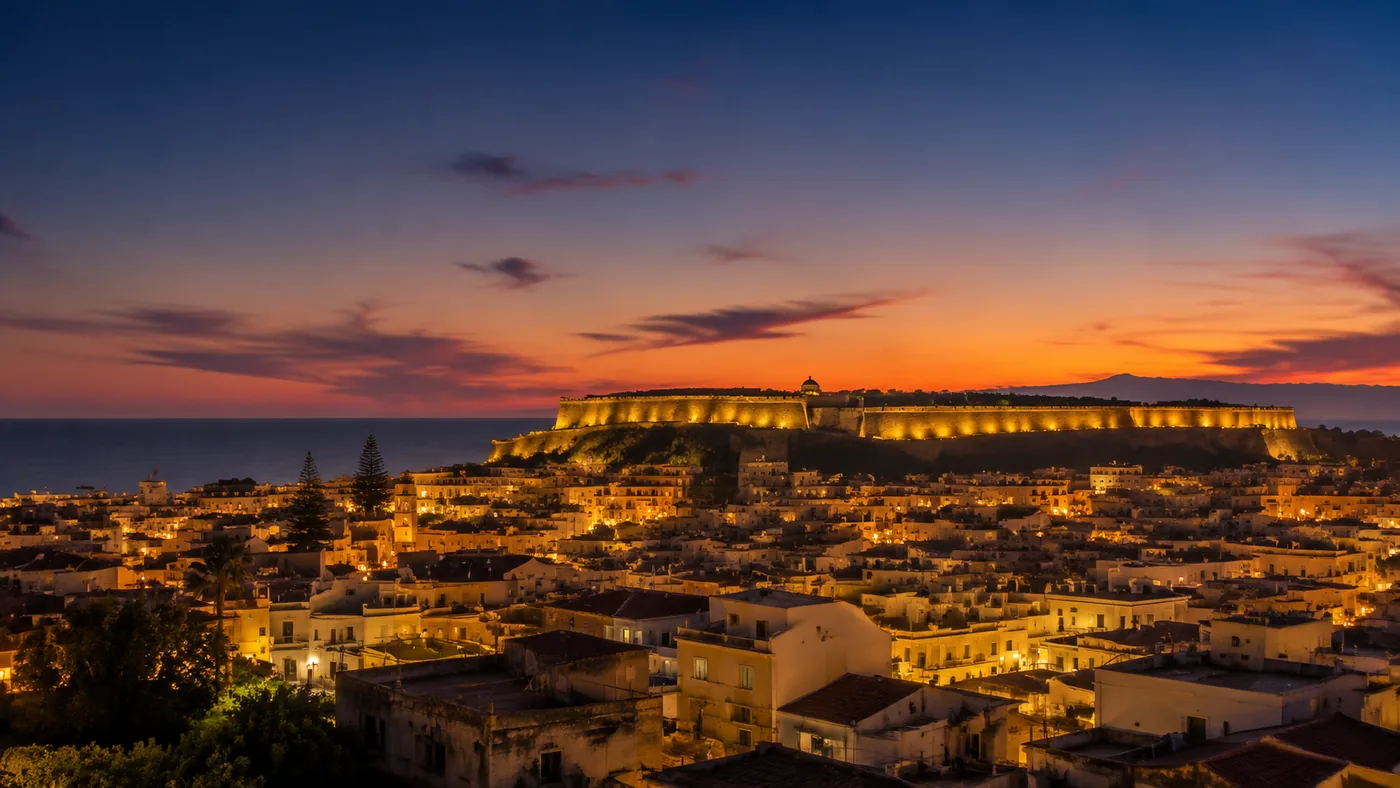
I grew up three streets below the Guora Gate and I have been walking visitors up to the Fortezza since 2009. The question I get most often is not about the Venetians. It is whether the climb is worth the afternoon. To answer that you need to know why something this big is sitting on a hill above a town this small.
Why a fortress this size exists here
In 1571 the Ottoman admiral Uluç Ali Reis sacked Rethymno. The same year Cyprus fell to the Ottomans, which left Crete as Venice’s largest overseas possession and made the defence of its towns urgent rather than theoretical. Paleokastro hill, on the west side of the town, had already held the acropolis of ancient Rhithymna. Venice built on it.
The stated purpose was to shelter the whole population of the town during an invasion. It was too small to do that, and everyone involved must have known it. What went up instead was a garrison fort with an administrative quarter inside, which is a different thing.
Who built it, and at what cost
Construction began on 13 September 1573 and was finished by 1580. The design came from the military engineer Sforza Pallavicini, working on the Italian bastioned system: low, thick, angled walls built to absorb cannon fire rather than tall walls built to stop ladders. The master builder was Giannis Skordilis. The plan is irregular because the hill is irregular, and the walls run 1,307 metres in total around four demi-bastions: St Nicolas on the east, St Paul (also called Santa Maria) on the southeast, St Elias on the south and St Lucas on the southwest.
The labour was forced. 107,142 Cretans and 40,205 animals were put to work on it. I say that number out loud on every tour, because a wall you have paid five euro to look at reads differently once you know who carried the stone. The main gate faces east, between St Nicolas and St Paul, and there are two smaller gates on the west and north sides that most visitors never find. If you want the practical version of that, it is on where the entrance is.
Six weeks in 1646
The fort had one famous day and then six bad weeks. On 29 September 1646, during the Fifth Ottoman–Venetian War, an Ottoman force besieged Rethymno and the town’s population retreated inside the walls. Disease, food shortages and running out of ammunition finished it. The Venetians surrendered on favourable terms on 13 November 1646.
What happened next is the interesting part. The Ottomans changed very little. They added the ravelin outside the main gate, garrison housing and administrative buildings, and they converted the Cathedral of St Nicolas into the Mosque of Sultan Ibrahim. That domed building is still the most photographed thing on the hill, and the reason it has a dome is that it was a cathedral first. The fort stayed in military use into the early 20th century.
What survives, and what does not
By the early 20th century the inside of the fortress was full of houses. After the Second World War most of them were demolished, along with the town’s landward walls. For a while the place was a local prison. Large-scale restoration began in the early 1990s, and it is now managed by the Greek Ministry of Culture and Sports and open to the public.
So the interior is emptier than the maps suggest. The mosque stands. So do the churches of St Theodore and St Catherine, both built in the late 19th century, and the bishop’s residence near the mosque. Of the House of the Rector, the Venetian governor’s residence, only the prisons survive. The Council Building, the armoury, two gunpowder magazines, storage rooms and several cisterns are all still there to walk through. The Erofyli open-air theatre on the St Elias bastion is the newest thing up here: it opened in 1993 and it is used for concerts and festivals in summer. The full walk-through is on what to see inside.
Should you pay a guide?
Here is the straight answer. Adult admission is about €5 at the gate, around €3 reduced, and there is no online booking for the site itself. Allow 1.5 to 2 hours. If you are happy reading a board and looking at a view, walk in alone and keep your money. Plenty of people should. The signage will not lie to you.
What a guide adds is the part the signage leaves out: why 1,307 metres of wall was worth building at all, what six weeks in the autumn of 1646 did to the town, and why the mosque has a dome. The one tour whose subject is the inside of the fortress runs 1 to 1.5 hours, costs €55 and includes the admission ticket, so the real difference is about €50 for the explanation. It is a new listing with a single five-star review, which is one review, not a track record. I would rather tell you that than let you assume the number means more than it does. Compare it against the alternatives on guided Fortezza tours and all six Rethymno tours.
One last practical thing, since it decides more visits than the history does. The ground is rocky, unpaved and uphill, there are no lifts or ramps, and there is almost no shade. Closed shoes, water, and the first hour after opening or the last two before closing. In July and August that is not advice, it is the difference between a good afternoon and a bad one. See the best time to visit.
Ready to walk up?
If you want the fortress explained on the spot rather than read about, the guided fortress tour is the only one whose subject is the inside of the walls, and it includes the gate ticket. If you would rather have the whole old town, start with the old town tours instead.
Frequently asked questions
What is the Fortezza of Rethymno?
It is a Venetian citadel on Paleokastro hill above Rethymno old town in Crete, begun on 13 September 1573 and finished in 1580. Its walls run 1,307 metres around four demi-bastions, and inside are the Sultan Ibrahim mosque, two 19th-century churches, the Rector’s prisons and the Erofyli theatre. See what to see inside.
How much does it cost to go in?
Adult entry is about €5, paid at the gate, with a reduced rate around €3 for children, students and over-65s. There is no online booking for the site itself. Full breakdown on the entrance fee page and the cost page.
Do I need a guide to visit the Fortezza?
No. It is a self-guided walk and most people do it alone. A guide is worth it if you want the 1646 siege, the Venetian defence logic and the cathedral-to-mosque story explained rather than guessed at. Compare the options on guided tours.